

We help organisations improve software quality, reduce defects, and accelerate delivery by implementing a structured Test-Driven Development optimisation framework aligned directly to business requirements.
Our approach ensures that test cases are defined before development begins, giving engineering teams absolute clarity on expected outcomes and reducing ambiguity in implementation. Instead of relying on post-development validation to identify gaps, we establish measurable acceptance criteria upfront—ensuring quality is built into the development lifecycle rather than inspected at the end.
We work closely with product, QA, and engineering teams to translate business requirements into structured test scenarios that capture expected functionality, edge cases, and failure conditions. These test cases form a shared understanding of success and serve as the foundation for development, validation, and release confidence.
Where appropriate, test cases are integrated into automated pipelines, ensuring continuous validation as the application evolves. Over time, this creates a scalable quality framework that protects against regressions, improves maintainability, and supports faster release cycles without compromising stability.
Our TDD optimisation approach introduces clear governance, standardised templates, and defined handoff checkpoints—ensuring that requirements, development, and validation remain consistently aligned. This results in improved collaboration across teams, reduced rework, and a more predictable path from concept to deployment.
By embedding business-driven validation into the development lifecycle, we help organisations achieve sustainable improvements in product quality, engineering efficiency, and delivery confidence—enabling teams to scale faster with lower long-term technical risk.
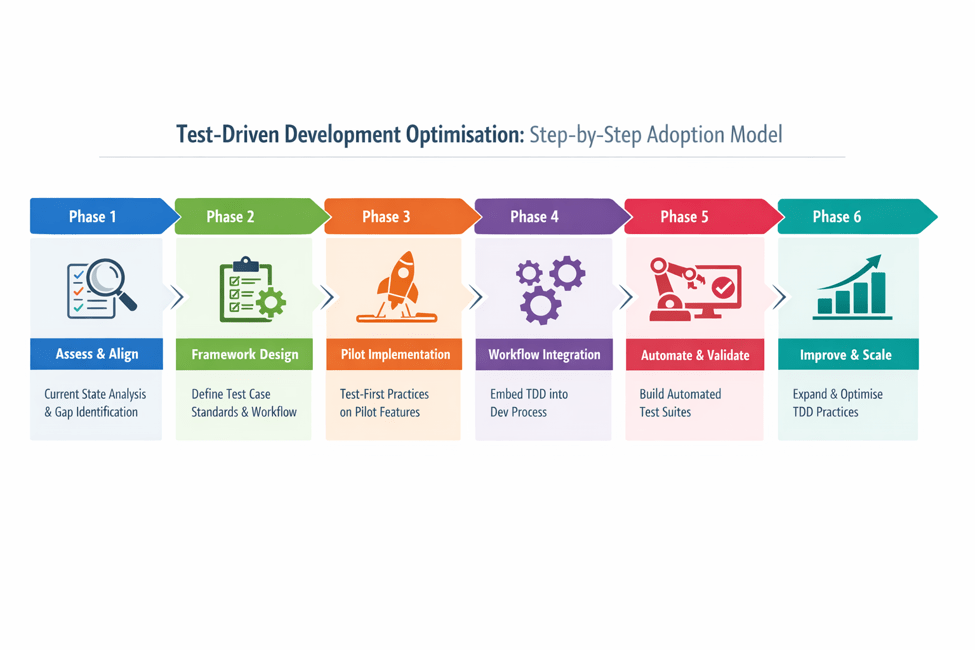
Our approach focuses on introducing TDD in a practical, phased manner, ensuring teams see immediate benefits without slowing delivery velocity.
We evaluate how requirements, development, and testing currently interact across teams.
Activities
Outcome
We establish a structured model for defining test cases before development begins.
Activities
Outcome
We introduce TDD practices on a controlled set of features or modules.
Activities
Outcome
We embed TDD practices into the standard delivery lifecycle.
Activities
Outcome
Where appropriate, we support the conversion of test cases into automated tests.
Activities
Outcome
We refine the framework based on delivery insights and expand coverage across teams.
Activities
Outcome
Brickendon is brought in when programmes are off-track, losing control, or too critical to fail.
We do not advise from the sidelines.
We take full accountability for recovery and delivery, embedding senior operators directly into execution. We reset governance, ownership, and delivery control, and stabilise programmes quickly before driving them through to completion.
No leveraged teams.
No separation between oversight and execution.
Just control, clarity, and delivery under pressure.
Confidential. No obligation. Senior conversation from day one